Picture this
You want exposure to Bitcoin mining, but not the whine of ASIC fans, not the heat, not the power bills, and definitely not the "why is the breaker tripping again?" puzzle at 2 a.m. That's why people try Bitcoin cloud mining: you rent SHA-256 hashrate from a professional facility, the data center does the heavy lifting, and you receive your share of rewards without building a mini‑power plant at home.
What exactly is Bitcoin cloud mining?
In plain English: you pay for a slice of computing power in a professional Bitcoin mining farm. Your share contributes to finding valid blocks on the Bitcoin network (Proof‑of‑Work). When blocks are found, rewards get split by contribution and contract rules, then paid out to you (minus any fees spelled out up front).
Key difference from "mining at home": no hardware buying, no thermal drama, no noise, no soldering irons, and no repair tickets. You subscribe; the farm runs; you track.
How the process works (step‑by‑step)
- Pick a provider and a Bitcoin plan (hashrate + term + fee model).
- Activate your plan; the provider allocates your share of real SHA‑256 capacity.
- Your hashrate contributes to a mining pool (because variance).
- Rewards accrue per the pool's payout scheme (e.g., PPS, FPPS, PPLNS).
- The platform credits payouts to your account and you withdraw to your wallet.
You don't touch firmware, racks, or breakers. You monitor from a dashboard.
The three common models
(and why they matter)
- Hardware – You own an ASIC, but it lives in someone else’s facility.
Pros: control and potential resale value. Cons: higher upfront cost and more logistics.
- Leased Hashpower – You rent a slice of hashrate for a fixed time.
Pros: lowest barrier to entry, quick start. Cons: less control, contract dependence.
- Marketplaces – Dynamic buy/sell of hashrate by the hour/day.
Pros: flexibility, opportunistic pricing. Cons: more management and fee awareness.
Why Bitcoin specifically?
Because Bitcoin's mining uses SHA‑256 ASICs and runs at industrial scale. Profitability hinges on efficiency, electricity price, network difficulty, and the block reward. After the 2024 halving, the block subsidy is 3.125 BTC per block, so every point of efficiency matters. Cloud providers aim to squeeze cost out with location, cooling, and power deals most individuals can't get at home.
Pros (what users like)
- No hardware headaches — no noise, heat, or repair queues.
- Fast onboarding — from sign‑up to earning can be same day.
- Geography arbitrage — benefit from cheaper power regions without moving.
- Predictable ops — professional uptime, monitored 24/7, clean reporting.
- Scalability — add or pause capacity based on your plan and risk appetite.
Cons (real talk)
- Counterparty risk — you rely on the provider to operate and pay.
- Fee drag — maintenance and pool fees reduce the net; understand them.
- Market exposure — BTC price and difficulty move; returns are not fixed.
- No residual hardware (with leased hashrate) — you rent, not own.
None of these are deal‑breakers if you price them in. They become deal‑breakers if you ignore them.
What drives Bitcoin cloud‑mining profitability
- Network difficulty & total hashrate – more competition → fewer sats per TH/s.
- BTC price – same rewards can be worth more/less in fiat overnight.
- Contract economics – TH/s price, duration, and how maintenance is charged.
- Pool payout scheme – PPS/FPPS/PPLNS changes variance and timing.
- Uptime & efficiency – less downtime, newer ASICs, smarter cooling = better yield.
- Halvings – the block reward schedule matters; plan around it.
Fees you should expect (and negotiate with yourself)
- Maintenance/power – often quoted per TH/s/day.
- Pool fee – the pool's cut (e.g., ~1–3%).
- Withdrawal fee – either a fixed BTC amount or tiered.
- "Miscellaneous" – only acceptable if clearly documented in the contract.
A good provider writes these in plain language and shows them line by line on your statement.
Picking a provider: a 60‑second due‑diligence checklist
- Is the company verifiable? Registration, real facility photos, team, location.
- SLA & transparency – uptime promises, maintenance schedule, pool disclosed.
- Payout proof – long‑term users actually withdrawing regularly.
- Support – response within hours, not weeks.
- No "guaranteed APR" –Bitcoin doesn't work like a fixed‑income bond.
If you see countdown timers, sky‑high promises, or "VIP only" yield multiples, you already have your answer.
Environmental angle (because it matters)
Bitcoin mining is energy‑intensive. Cloud operations can mitigate impact by:
- locating near renewables (hydro, wind, geothermal),
- using free‑air cooling or cool climates,
- applying AI load balancing to smooth peaks,
- and reusing heat for industrial or residential applications where possible.
The footprint isn't zero; the point is to verify the provider's energy mix and efficiency claims instead of accepting vague "green" badges.
Taxes, compliance, and record‑keeping
- Income at receipt – payouts are typically ordinary income at fair market value when credited.
- Capital gains – later sales of mined BTC can trigger gains/losses.
- Keep logs – payout times, amounts, fees, wallet TXIDs, and price at receipt.
- Local rules vary – check your jurisdiction, both where you live and where the provider operates.
Not exciting, but essential. A tidy spreadsheet beats guesswork in April.
Bitcoin cloud mining vs staking
(quick context)
They're different animals. Mining secures Bitcoin's PoW chain with compute. Staking secures PoS chains with collateral. Staking yields can look steadier; mining is more cyclical but tied to Bitcoin's monetary schedule. Many users diversify: hold some BTC, mine a bit, stake elsewhere.
Common myths to drop at the door
- "It's passive and always profitable." It's passive‑ish and market‑dependent.
- "All cloud mining is a scam." No but opacity is common. Pick transparency.
- "Start big or don't bother." Start small, test, and scale if the numbers work.
- "Halvings kill mining." They compress margins; efficient operations adapt.
How to start (the practical playbook)
- Decide your cap. Pick a number you can learn with (and sleep with).
- Compare plans. Look at TH/s pricing, term, and maintenance formulas.
- Run scenarios. Use conservative BTC price and rising difficulty in your model.
- Start small. Validate payouts and withdrawals in practice.
- Measure net, not gross. Track rewards minus all fees.
- Scale gradually. Increase only if your real numbers meet your target.
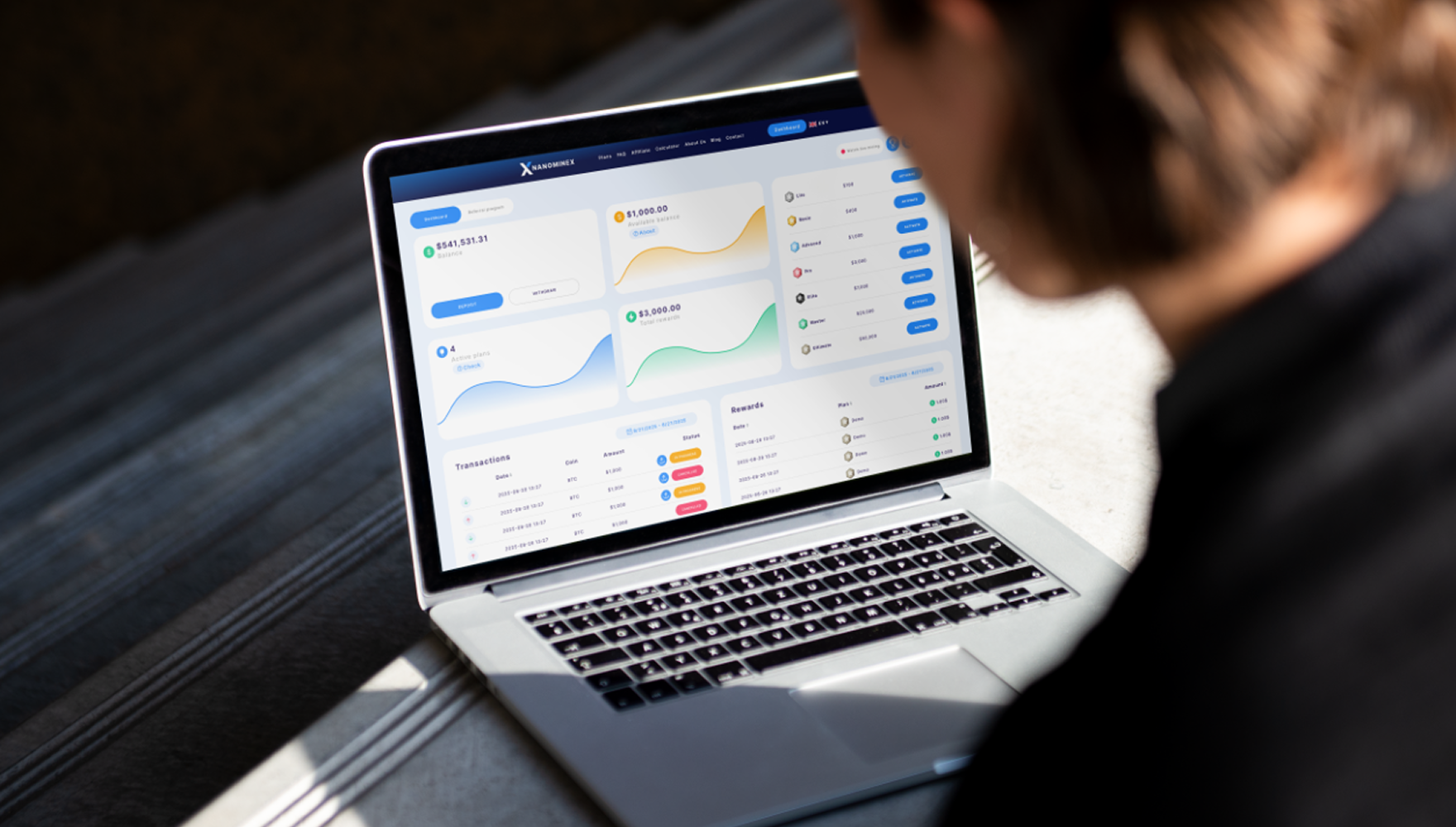
When you're ready to test a live plan, you can do it on NanoMinex — spin up a small BTC contract, watch daily payouts, and see how the dashboard feels before committing more.
Mistakes I see beginners make (and how to avoid them)
- Chasing banners, not math. Always run the numbers yourself.
- Ignoring fees. Maintenance and pool cuts aren't small; price them in.
- All‑in on day one. Don't. Prove the process first.
- Wrong wallet habits. Use a secure, well‑backed wallet; test a small withdrawal.
- No logs. Keep a simple sheet—date, payout, fees, BTC price—to stay objective.
FAQ (micro‑answers you'll actually use)
How often are BTC payouts made?
Commonly daily. Exact cadence depends on the pool and provider policy.
Can I change plans mid‑term?
Some providers let you upgrade or extend; read the contract and how fees reset.
What if BTC dumps?
Your payouts in BTC continue, but fiat value changes. That's market risk; plan for it.
Do I need to run anything at home?
No — just your account and a secure wallet for withdrawals.
Is there a "best" contract length?
Longer terms can offer lower TH/s rates but increase counterparty risk. Laddering smaller terms is a popular compromise.
Bottom line
Bitcoin cloud mining isn't a magic printer. It's a clean way to participate in PoW rewards without turning your spare room into a server closet. If you value simplicity, transparency, and the ability to scale at your pace, it can be a solid tool in your crypto toolkit.
Start small. Track everything. Let the numbers, not the marketing, tell you what to do next.