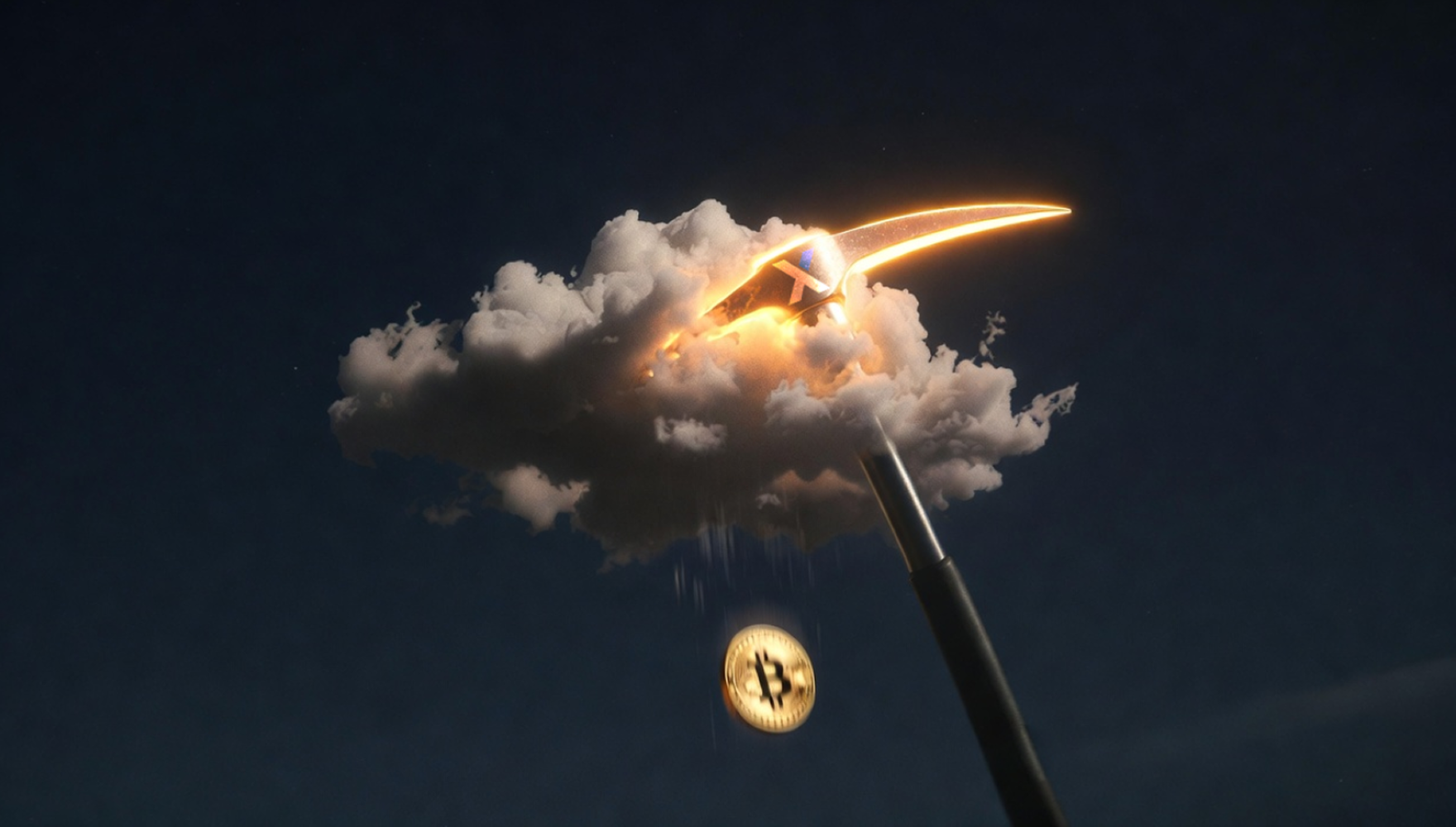
In the simplest terms, cloud mining means renting computing power from a data center that does the heavy lifting for you. The company owns and manages industrial-grade mining equipment, while you lease a portion of its processing capacity — often measured in "hash rate." When that equipment mines a block, you earn your share of the reward, automatically credited to your account. No cables, no noise, no maintenance. Just digital infrastructure working quietly on your behalf.
Here's the basic flow:
1. You choose a mining plan — decide how much power you want to rent and for how long.
2. The provider allocates that share from their farm's total capacity.
3. The mining software contributes your share to a large mining pool.
4. When rewards are distributed, you receive your part according to the plan you selected.
The process feels like a subscription — you pay for access, and your account starts generating daily rewards.
Let’s break it down:
1. Network difficulty: When more miners join, rewards per user shrink.
2. Coin price: If BTC or LTC jumps, profits grow — and vice versa.
3. Contract terms: Duration, fees, and payout scheme all play a role.
4. Hardware efficiency: Newer ASICs perform better with less power.
5. Uptime: Every hour offline means lost earnings.
If you want a quick way to estimate returns, many platforms (including NanoMinex) provide built-in calculators to model potential earnings.
If a website promises guaranteed high returns (especially triple-digit ones) or pushes aggressive countdowns — run the other way.
For most users, cloud mining acts as a "starter bridge" — a way to understand how mining works before building something themselves.
The crypto world now offers two main passive income paths: mining (Proof-of-Work) and staking (Proof-of-Stake).Mining earns rewards for validating transactions through computational power.Staking locks coins to secure a network and earns interest-like yields.
Mining generally offers higher long-term upside but carries more operational risk.
Staking is steadier but depends on token liquidity and protocol rules. Smart investors often diversify — a little staking, a little mining — balancing risk and reward.
Energy use has always been the elephant in the room for mining. Modern cloud farms tackle it with smarter cooling and renewable energy — hydro, wind, geothermal — and AI-based load balancing. Iceland, Canada, and parts of Central Asia now host some of the world’s most efficient green mining centers.
Mining income is usually taxable as ordinary income when received. Later, if you sell mined coins, capital gains may apply. Rules vary widely by country, so it’s smart to keep detailed records of payouts, fees, and wallet addresses. Always double-check if your jurisdiction requires specific disclosures or limits cloud mining activity.
In 2026, mining efficiency depends not just on hardware but on data.
AI now predicts optimal times to allocate hash power, detects downtime instantly, and adjusts power loads to save energy.
For users, that means better stability and smoother payouts — all managed automatically in the background.
1. Set your budget. Only use what you can afford to invest.
2. Research. Compare plans, read reviews, test small first.
3. Pick your provider. Look for verified operations and real payout history.
4. Track results. Log daily rewards, note network changes.
5. Reinvest smartly. Expand only if numbers make sense.
If you’re ready to see how simple modern mining can be, explore the plans at
NanoMinex — the platform built for both beginners and experienced miners who want
mining made easy, secure, and transparent.
Cloud mining isn’t a get-rich scheme; it’s a modern tool.
It opens the door for anyone to take part in the crypto ecosystem without turning their living room into a data center.
Success comes down to knowledge, patience, and choosing platforms that treat users as partners, not statistics.
If that’s what you’re looking for — simplicity, clarity, and real performance — then it might be time to start small and see where the numbers take you.
Because in the end, the goal isn’t just to mine crypto.
It's to mine experience, to understand how this world works, and to grow alongside it.